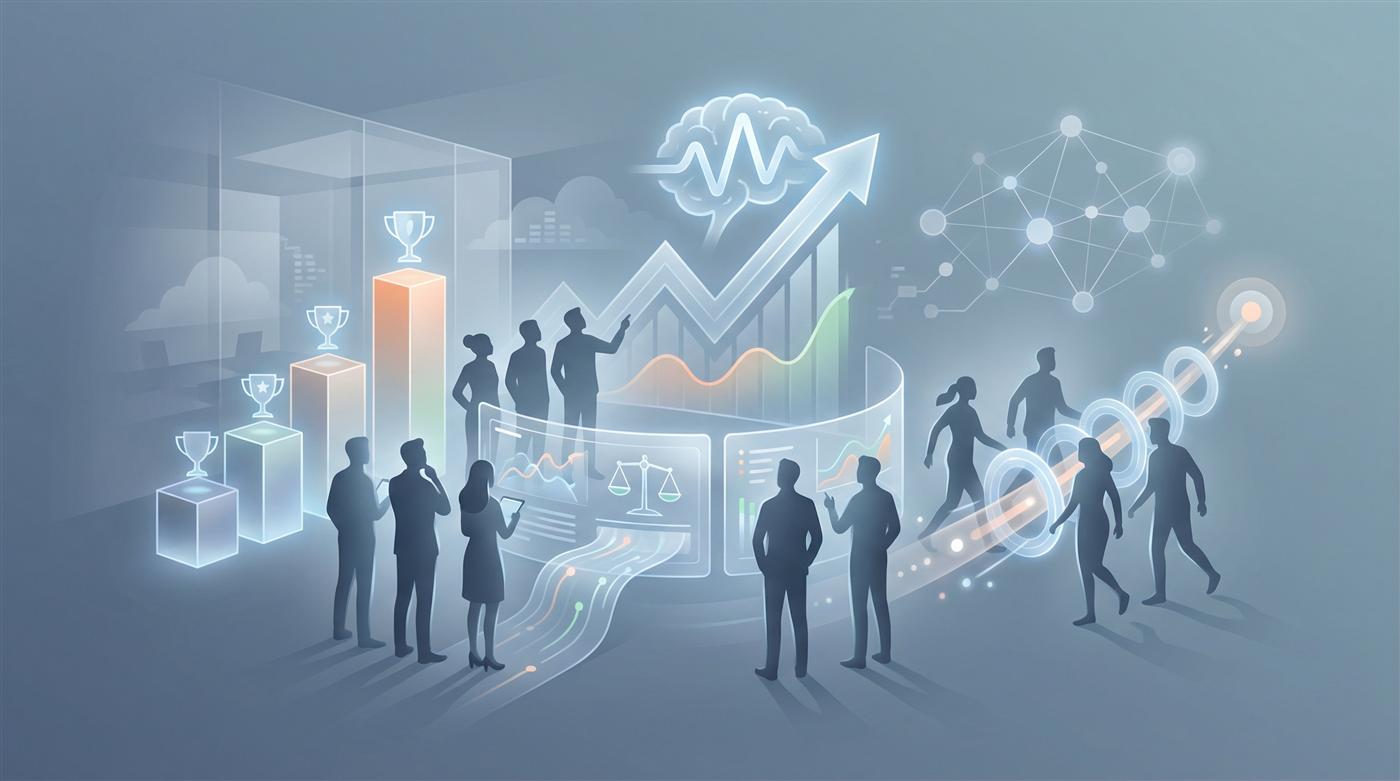
The Showroom as a Behavioral Environment
Walk onto any sales floor and you're entering a behavioral environment. Every element shapes how people act: the layout, the noise level, where managers sit, what's visible, what's hidden. Most dealerships don't think about this consciously. They inherit the floor plan and work around it. But the environment is always teaching people how to behave.
The most powerful element in this environment isn't the desk layout or the break room. It's information. What people can see shapes what they do. And in most dealerships, the information that matters most is nearly invisible.
Social Comparison Theory
Psychologists have understood for decades that humans gauge their own performance by looking at others. This is called social comparison theory. We don't evaluate ourselves in isolation. We evaluate ourselves relative to our peers.
On a sales floor, this means salespeople are constantly wondering where they stand. Am I ahead? Behind? Who's winning today? Who just sold something? This mental calculus runs constantly, whether managers want it to or not.
The question isn't whether salespeople compare themselves to each other. They do. The question is what information they're using to make those comparisons.
When the information is hidden, salespeople fill in the blanks with rumors, assumptions, and anxiety. When the information is visible, they focus on facts. The comparison happens either way. Visibility just makes it accurate.
The Feedback Loop Problem
Every effective performance system relies on feedback loops. Do something, see the result, adjust, repeat. The tighter the loop, the faster people improve. The looser the loop, the more behavior drifts.
In most dealerships, the feedback loop for sales performance is measured in weeks or months. A salesperson sells a car today. They might hear about it in a morning meeting tomorrow. They'll see it on a pay statement in two weeks. They'll know their true standing relative to peers at month-end.
That's not a feedback loop. That's a feedback canyon. The action and the consequence are so far apart that the connection becomes abstract.
Compare this to what salespeople experience in every other part of their lives. Social media provides instant feedback. Video games reward every action immediately. Fitness apps track progress in real time. Then they come to work and enter an environment where success is invisible until someone remembers to update a whiteboard.
The Page Two Effect
Something interesting happens when you put rankings on a visible scoreboard: people don't just try to be number one. They try not to be last. They try to stay on page one when the leaderboard paginates. They try to climb just one position.
This is the psychology of incremental competition. Most people don't expect to beat the top performer. But they do expect to improve their relative position. And that expectation, when visible, drives behavior.
The salesperson at position 12 isn't thinking about position 1. They're thinking about position 11. The gap feels closable. The competition feels real. And the visibility makes every sale meaningful.
"Nobody wants to live on page two."
When leaderboards paginate and visibility is public, the fear of falling to page two motivates as much as the desire to climb. This isn't shame. It's engagement. People care about their standing because they can see it.
The Slow Day Illusion
Every salesperson has experienced the "slow day" feeling. Nothing seems to be happening. Motivation drops. They start checking their phone. The showroom feels dead.
Often, the day isn't actually slow. Deals are happening. Colleagues are selling. But without visibility, the salesperson experiences isolation. They can't see the activity, so they assume there is none.
When today's sales are visible in real time, this illusion breaks. A salesperson checks the board at 2 PM and sees three deals have already closed. The day isn't slow. They're just behind. And that realization triggers a different behavior than resignation.
Visibility combats the psychological drift that happens when people feel disconnected from the collective momentum. It makes individual effort part of a visible whole.
Recognition in the Moment
Recognition that comes immediately is worth more than recognition that comes later. Psychologists call this temporal proximity. The closer the reward is to the behavior, the stronger the association.
When a salesperson closes a deal and their name immediately appears on a scoreboard, something happens in their brain. The effort and the acknowledgment are linked. They did the thing, and the thing was noticed, right now.
Compare this to recognition that arrives at a monthly meeting. "Great job last week, everyone." The connection is weak. The moment has passed. The recognition feels abstract rather than visceral.
Real-time visibility isn't just about data accuracy. It's about creating recognition systems where the reward and the action stay connected.
Goal Visibility Changes Commitment
When goals are private, they're easy to abandon. "I was going to hit 15 this month, but things got slow." Nobody knows. Nobody holds you accountable. The goal quietly dies.
When goals are visible, they become commitments. "Everyone saw I set a goal of 15. They can see I'm at 12. I need to close three more." The social pressure isn't punitive. It's motivating. The goal matters because others can see whether you hit it.
This is why the best performance systems don't just track results. They track progress toward stated goals. They make the gap between current state and desired state visible to everyone.
Salespeople don't just compete against each other. They compete against their own stated objectives. And that competition becomes real when others can see it.
The Collective Energy Shift
Something changes in a showroom when real-time performance is visible. The energy shifts. People move differently. Conversations have an edge. The room feels alive.
This isn't mysticism. It's the aggregate effect of everyone knowing the score. When the scoreboard is hidden, people operate in isolated bubbles. When the scoreboard is visible, they operate as part of a shared game.
That shared game creates collective momentum. A good day for one person becomes visible energy for everyone. A strong push from one salesperson sparks effort from others. The visibility creates a feedback system across the entire team, not just within individual performance.
Visibility Is Not Surveillance
A common objection to visibility systems is that they feel like surveillance. Big Brother watching. Constant monitoring. Pressure that breaks people rather than motivates them.
But visibility and surveillance are not the same thing. Surveillance is asymmetric. Management watches employees, but employees can't see the full picture. The power flows one direction.
True visibility is symmetric. Everyone sees the same truth. The salesperson sees their ranking, but they also see the ranking of everyone else. The manager sees performance, but so does the entire team. The information is shared, not hoarded.
This distinction matters. Surveillance breeds resentment because it's about control. Visibility breeds engagement because it's about fairness. When everyone sees the same scoreboard, the competition feels legitimate.
Designing for Behavior
The psychology of the sales floor isn't random. It can be designed. The question is whether you're designing intentionally or accepting whatever environment you inherited.
Intentional design means asking: What information do people need to see? When do they need to see it? How should it be displayed? What behaviors does visibility encourage?
The dealerships that understand behavioral psychology don't just track performance. They create environments where the right behaviors emerge naturally from the information structure. Where competition motivates without becoming toxic. Where recognition happens in real time. Where goals are visible and shared.
That environment doesn't happen by accident. It happens by design.
What Does Your Floor See?
Visibility changes behavior. See what real-time performance looks like in action.
Learn About SalesLane